Our audiology services include hearing evaluations, hearing aids, implants, hearing protection and speech therapy. We care for every age — from newborn screenings to adult tinnitus care — and offer full support for families.
What is an audiologist?
Audiologists are hearing healthcare professionals who evaluate and diagnose hearing concerns and recommend treatment. They specialize in hearing aids and implantable hearing devices, and practice in settings such as hospitals and private clinics.
Understanding hearing loss
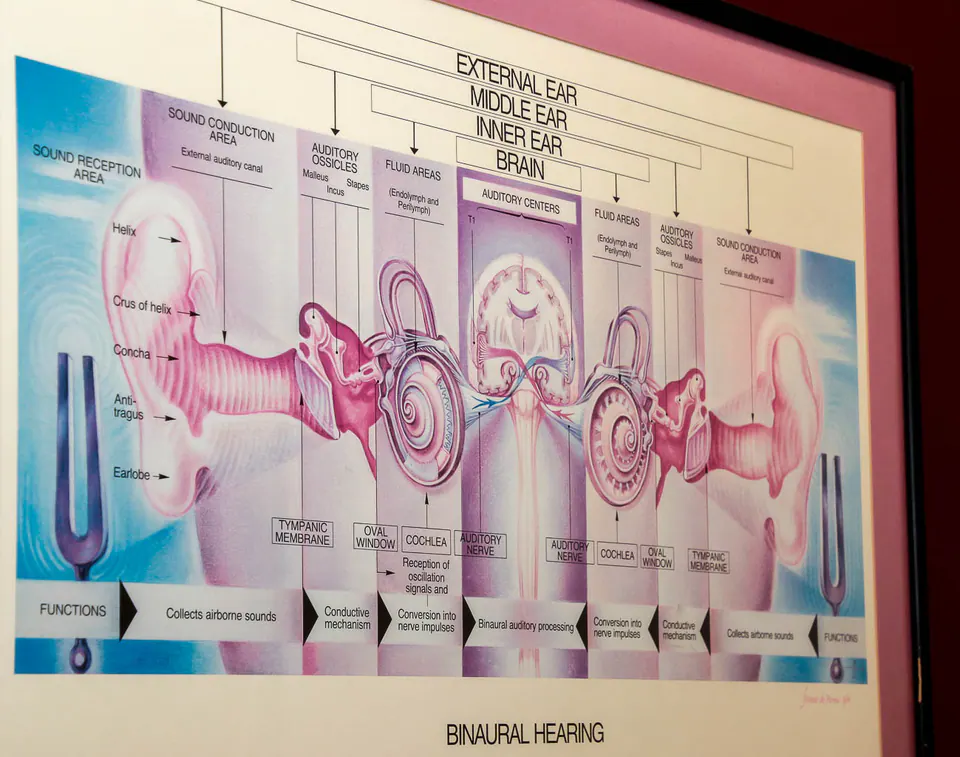
Hearing loss can involve the ear, the auditory nerve or the brain. It ranges from mild to profound and affects people of every age — about 1 in 8 people in the United States ages 12 and older has hearing loss in both ears.
Source: NIDCD, Quick Statistics About Hearing (opens an external website)
There are three main types
- Conductive
Sound can’t pass through the outer or middle ear properly.
- Sensorineural
The inner ear or the nerve pathways to the brain are affected.
- Mixed
A combination of conductive and sensorineural hearing loss.
Common causes
Ear infections, fluid buildup, loud noise, aging, genetics and head trauma.
Signs to watch for
In adults
- Difficulty hearing in background noise
- Needing the volume higher than others do
- Ringing in the ears
In children
- Delayed speech
- Not responding to sound
If you notice any of these signs, a hearing test is the first step toward treatment.
Do I need medical treatment?
Sometimes hearing trouble has a medical cause that a doctor can treat. Part of every evaluation is finding out whether yours does.
Your results show where along the hearing pathway a problem starts. Some causes, like fluid, infection or a blockage in the outer or middle ear, may need a physician’s care, and we refer you to your doctor or an ear, nose and throat specialist (ENT) when they do. Other hearing loss is best managed with hearing devices, therapy and communication strategies. Some people need both.
Your hearing evaluation
Screening
A simple pass/fail check to see whether further evaluation is needed. Screenings are often done for newborns, children and adults in schools, clinics and health fairs.
Full audiological evaluation
If someone doesn’t pass a screening or shows signs of hearing loss, a full evaluation is recommended: a review of medical history, an ear exam and tests chosen for the person being seen.
Results and next steps
Your audiologist explains what the results mean and talks through treatment options with you.
Tests we may use
- Pure-tone and speech testing
Measures the softest tones you can hear across pitches and how clearly you understand speech.
- Tympanometry
Uses gentle air pressure to check how the eardrum moves and to identify middle-ear concerns. Our office uses Titan wideband tympanometry for advanced, 3D middle-ear diagnostics.
- Otoacoustic emissions (OAE)
A small probe measures the inner ear’s response to sound. OAE testing is commonly used in newborn screenings.
- Auditory brainstem response (ABR)
Measures how the hearing nerve and brain pathways respond to sound. More about ABR
Auditory brainstem response (ABR)
The ABR test measures how the inner ear and the brain’s hearing pathways respond to sound. Small electrodes placed on the head track brain-wave activity while the person being tested rests quietly or sleeps.
ABR is well suited to newborn screenings, to people who can’t complete standard hearing tests, and to anyone showing signs of hearing-related neurological concerns.
Hearing protection
Sounds around us
How loud is everyday life?
Choose a sound to see its average level in A-weighted decibels (dBA).
Normal conversation: about 60–70 dBA
A good rule of thumb: avoid noises that are too loud, too close, or last too long.
Source: NIDCD, Noise-Induced Hearing Loss (opens an external website)
Noise-induced hearing loss is permanent, but it is preventable. Loud noise — on the job or in daily life — can damage hearing over time.
Earmuffs and earplugs block or reduce harmful noise. Whether you work in construction or in music, there are solutions that fit your needs.
Tinnitus
Tinnitus is often described as ringing, buzzing or hissing in the ears with no outside source. Roughly 1 in 10 U.S. adults has experienced tinnitus lasting at least five minutes in the past year.
Source: NIDCD, Quick Statistics About Hearing (opens an external website)
Tinnitus is often linked to noise-induced hearing loss, but it can also stem from ear injuries or circulation problems. Most cases are subjective, meaning only the person with tinnitus can hear it.
There is no cure yet, but treatments such as hearing aids, sound therapy and tinnitus retraining can help manage symptoms.
Common questions
- Where can I get a hearing test in Burbank?
At our office at 2211 W. Magnolia Blvd., Suite 100, Burbank. Call (818) 859-7730 to schedule; our team can help in English or Spanish.
- What happens during a hearing evaluation?
A full evaluation may include a review of your medical history, an ear exam and tests such as tympanometry, speech and tone testing, otoacoustic emissions (OAE) or auditory brainstem response (ABR). Your audiologist then explains the results and next steps.
- How should I prepare?
Bring a photo ID, your insurance card, any referral or earlier hearing test records, your hearing aids if you use them, and a list of medications and health conditions. See your first visit.
- How do I know whether I need medical treatment?
Your evaluation shows where along the hearing pathway a problem starts. If the cause may need a physician’s care, such as fluid, infection or a blockage, we refer you to your doctor or an ear, nose and throat specialist (ENT). Sudden hearing loss is a medical emergency: see a doctor right away.
- Can an audiologist help with tinnitus?
Tinnitus has no cure yet, but treatments such as hearing aids, sound therapy and tinnitus retraining can help manage symptoms. An audiologist can evaluate your hearing and talk through options with you.
- Will my insurance cover a hearing test?
We accept most major insurance plans, including Medicare. See accepted insurance and call (818) 859-7730 to confirm your benefits.
Questions? We’re here to help.
Connect with our team for guidance about your care or your family’s next steps.